
1. Ulwazi Lokuphepha
Please read and understand all safety information and operating instructions before using this multimeter. Failure to follow these instructions may result in electric shock, fire, or damage to the meter.
- Always ensure the test leads are properly connected and the function switch is set to the correct range before making any measurements.
- Ungazami ukukala ivolumutages or currents exceeding the maximum rated values for this meter.
- Qaphela kakhulu lapho usebenza ngamasekethe abukhoma. I-Volt ephezulutages can be dangerous.
- Never open the meter casing unless specifically instructed for battery or fuse replacement. Ensure test leads are disconnected before opening.
- Shintsha ibhethri uma kuvela isibonakaliso sebhethri eliphansi ukuqinisekisa ukufundwa okunembile.
- Ungasebenzisi imitha uma ibonakala yonakele noma uma ukufudumala okusemaceleni okuhlola kuphazamisekile.
Umfanekiso 1: Ngemuva view of the Rebel MIE-RB-830 Multimeter, showing the battery compartment cover and a warning label. The label advises removing test leads before opening the case to avoid electrical shock and to install fuses with correct amp/volt ratings. It also indicates the power supply is a 9V battery, type NEDA 1604 9V 6F22.
2. Umkhiqizo Uphelileview
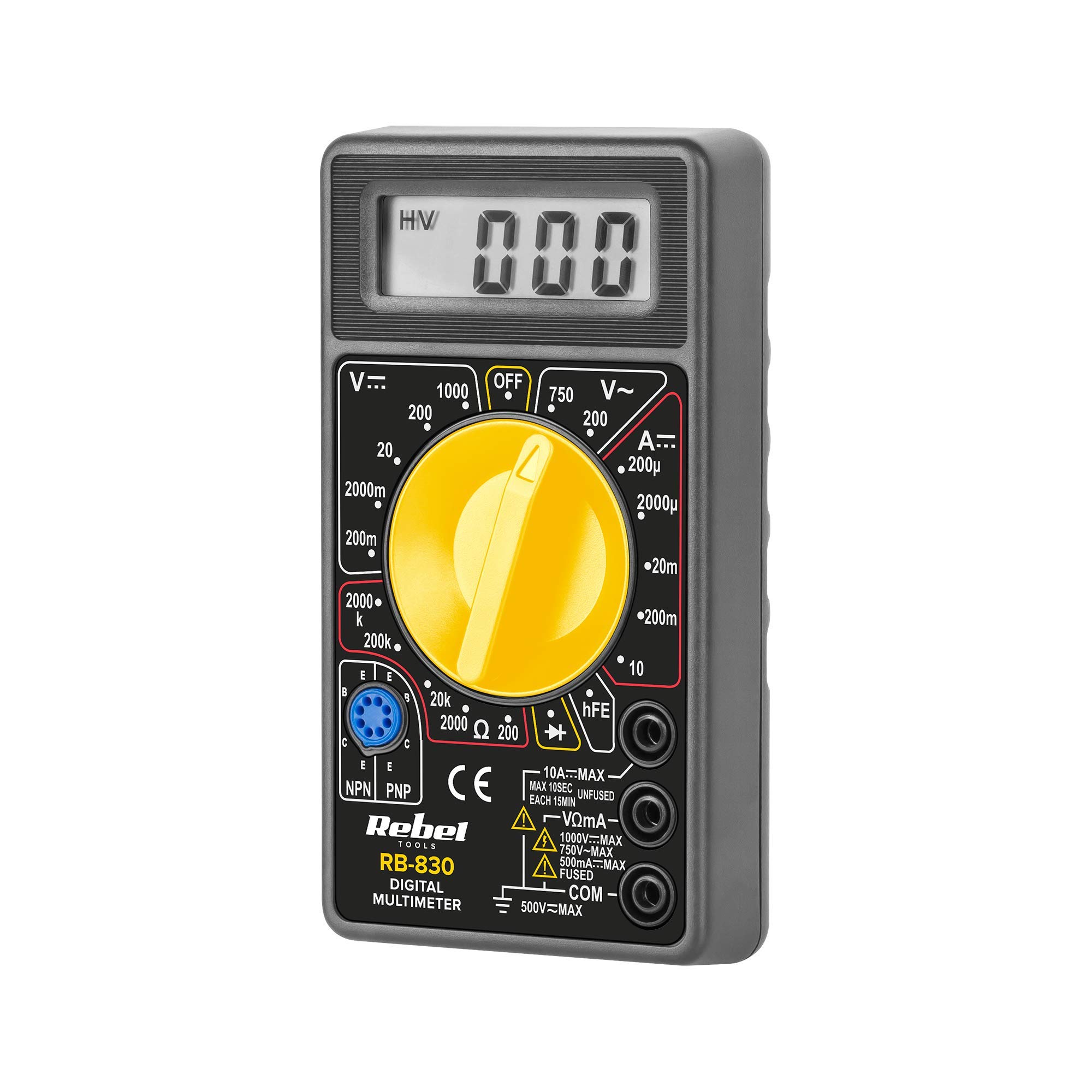
The Rebel MIE-RB-830 is a compact, battery-operated digital multimeter designed for measuring DC/AC voltage, DC current, resistance, diode, and transistor (hFE) values. It is suitable for general electrical testing and troubleshooting.
2.1. Izingxenye
- Digital Multimeter Unit
- Ama-Test Lead (Obomvu Nomnyama)
- 9V Battery (may be included or sold separately)
- Incwadi Yomsebenzisi (le dokhumenti)

Umfanekiso 2: The Rebel MIE-RB-830 Digital Multimeter shown with its accompanying red and black test leads. The multimeter features a large LCD display and a rotary function switch.

Umfanekiso 3: Eduze view of the red and black test leads. These leads are essential for connecting the multimeter to the circuit under test.
3. Setha
3.1. Ukufakwa kwebhethri
- Ensure the multimeter is turned OFF and all test leads are disconnected.
- Locate the battery compartment cover on the back of the meter (refer to Figure 1).
- Khulula izikulufo zokugcina bese ususa isembozo ngokucophelela.
- Insert a new 9V battery (NEDA 1604 or 6F22 type), observing the correct polarity (+ and -).
- Shintsha isembozo segumbi lebhethri bese usiqinisa ngezikulufo.
3.2. Ukuxhumanisa Abaholi Bokuhlola
- Xhuma i- ebomvu test lead to the "VΩmA" input jack.
- Xhuma i- mnyama test lead to the "COM" (common) input jack.
- For current measurements exceeding 200mA (up to 10A), connect the red test lead to the "10A" input jack.
4. Iziqondiso Zokusebenza
4.1. Ukukhetha Umsebenzi
Turn the rotary switch to the desired measurement function and range. Always start with a higher range if the approximate value is unknown to prevent overloading the meter.
4.2. Measuring DC Voltage (V–)
- Setha iswishi ejikelezayo ibe yi-DC Vol oyifunayotage (V–) range (e.g., 20V, 200V).
- Xhuma i-red test lead ohlangothini oluhle (+) lwesekethe kanye ne-black test lead ohlangothini oluhle (-).
- Funda ivolumutage value kusibonisi se-LCD.
4.3. Ukulinganisa i-AC Voltage (V∼)
- Setha iswishi ejikelezayo ibe yi-AC Vol oyifunayotage (V∼) range (e.g., 200V, 750V).
- Xhuma izinkomba zokuhlola ngaphesheya kwe-AC voltage umthombo.
- Funda ivolumutage value kusibonisi se-LCD.
4.4. Measuring DC Current (A–)
Isexwayiso: To measure current, the meter must be connected in series with the circuit. Never connect the meter in parallel with a voltagumthombo uma usemodini yamanje, njengoba lokhu kungalimaza imitha kanye nesekethe.
- Setha iswishi ejikelezayo ibe uhla olufunwayo lwe-DC Current (A–) (isb., 20mA, 200mA, 10A).
- For currents up to 200mA, ensure the red lead is in the "VΩmA" jack. For currents up to 10A, move the red lead to the "10A" jack.
- Vula isekethe lapho kuzolinganiswa khona ugesi bese uxhuma imitha ngokulandelana.
- Funda inani lamanje kusibonisi se-LCD.
4.5. Measuring Resistance (Ω)
Isexwayiso: Ensure the circuit or component under test is de-energized before measuring resistance.
- Set the rotary switch to the desired Resistance (Ω) range (e.g., 200Ω, 2kΩ, 200kΩ).
- Xhuma izintambo zokuhlola kulo lonke ingxenye noma isekethe okufanele ikalwe.
- Funda inani lokumelana esibukweni se-LCD.
4.6. Ukuhlolwa kwe-Diode (→|–)
- Set the rotary switch to the Diode Test (→|–) position.
- Connect the red test lead to the anode of the diode and the black test lead to the cathode.
- Isibonisi sizobonisa ivolumu yangaphambilinitagukwehla kwe-e (ngokuvamile kusuka ku-0.5V kuya ku-0.8V kuma-diode e-silicon).
- Reverse the leads. The display should show "OL" (Open Loop) for a good diode.
4.7. Ukuhlolwa kwe-Transistor (hFE)
- Setha iswishi ejikelezayo endaweni ye-hFE.
- Identify if the transistor is NPN or PNP.
- Insert the transistor's emitter, base, and collector leads into the corresponding sockets on the hFE test socket.
- Read the hFE (DC current gain) value on the display.
5. Isondlo
5.1. Ukushintshwa Kwebhethri
When the low battery indicator appears on the display, replace the 9V battery as described in Section 3.1. Using a low battery can lead to inaccurate readings.
5.2. Ukushintshwa kwe-Fuse
If the current measurement function stops working, the fuse may need replacement. This operation should only be performed by qualified personnel.
- Ensure the multimeter is turned OFF and all test leads are disconnected.
- Open the back casing of the meter (this may involve more screws than just the battery compartment).
- Locate the blown fuse and replace it with a fuse of the exact same type and rating (e.g., F200mA/250V for mA range, F10A/250V for 10A range). Refer to the internal markings or specifications for precise fuse ratings.
- Hlanganisa kabusha imitha ngokucophelela, uqinisekise ukuthi zonke izikulufo ziqinisiwe.
5.3. Ukuhlanza
Sula imitha ngesikhangisoamp cloth and mild detergent. Do not use abrasives or solvents. Keep the meter dry.
6. Ukuxazulula izinkinga
| Inkinga | Imbangela Engenzeka | Isixazululo |
|---|---|---|
| Asikho isibonisi noma isibonisi esifiphele | Ibhethri liphansi noma elifile | Faka esikhundleni sebhethri le-9V. |
| Ukufundwa okungalungile | Low battery; Incorrect range selection; Poor test lead connection | Replace battery; Select appropriate range; Ensure leads are firmly connected. |
| Ukulinganisa kwamanje akusebenzi | Blown fuse; Incorrect lead connection for current | Replace fuse (see Section 5.2); Ensure red lead is in "VΩmA" or "10A" jack as appropriate. |
| "OL" (Ukulayisha ngokweqile) kubonisiwe | Measured value exceeds selected range; Open circuit (for resistance/continuity) | Khetha ububanzi obuphezulu; Hlola isekethe ukuthi azikho yini izikhawu. |
7. Imininingwane
| Umsebenzi wokulinganisa | Ibanga | Ukunemba |
|---|---|---|
| I-DC Voltage (V–) | 200mV, 2V, 20V, 200V, 1000V | ±(0.5% + 2 amadijithi) |
| I-AC Voltage (V∼) | 200v, 750v | ±(1.2% + 10 amadijithi) |
| I-DC Current (A–) | 200µA, 2mA, 20mA, 200mA, 10A | ±(1.0% + 2 amadijithi) |
| Ukumelana (Ω) | 200Ω, 2kΩ, 20kΩ, 200kΩ, 2MΩ | ±(0.8% + 2 amadijithi) |
| Ukuhlolwa kweDiode | Yebo | Phambili voltage kwehle |
| Ukuhlolwa kwe-Transistor (hFE). | Yebo | hFE value |
| Ukunikezwa kwamandla kagesi | Ibhethri le-9V (NEDA 1604 noma 6F22) | |
| Bonisa | 3½ Digit LCD, Max. 1999 | |
| Ubukhulu | Okusondele. 13.5 x 10 x 4 cm | |
| Isisindo | Approx. 107 grams (without battery) | |
| Izinga Lokushisa Lokusebenza | 0°C ukuya ku-40°C (32°F ukuya ku-104°F) | |
| Izinga Lokushisa Lesitoreji | -10°C kuya ku-50°C (14°F kuya ku-122°F) | |
| Amazinga Okuphepha | CE, RoHS |
8. Iwaranti kanye Nokusekela
This Rebel MIE-RB-830 Digital Multimeter is covered by a standard manufacturer's warranty against defects in materials and workmanship. Please refer to the warranty card included with your purchase or contact your retailer for specific warranty terms and conditions.
For technical support or service inquiries, please contact the point of purchase or visit the official Rebel webindawo yolwazi lokuxhumana.